8. Elections and Electoral Systems

Comparative Politics

Giacomo Lemoli

From Last Class

  • We have analyzed how electoral outcomes (voters’ choices) affect government

  • We treated voters’ choices as “given” and focused on what comes later

  • Today: how the “rules” affect voters’ choices and electoral outcomes

Electoral Systems

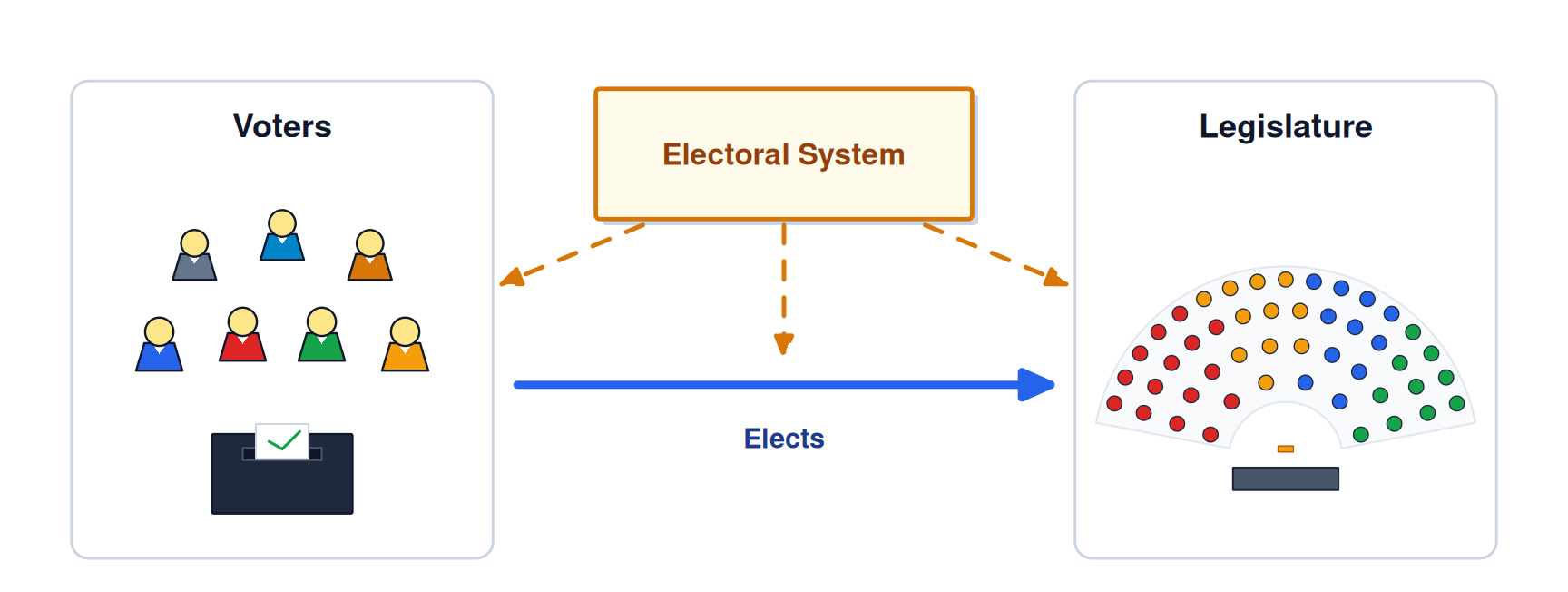
An electoral system is a set of laws and regulations that govern the electoral competition between candidates and parties (Cox 1997)

Including:

  • Electoral formula \(\rightarrow\) how votes are translated into seats
  • Ballot structure \(\rightarrow\) whether to vote for candidates or parties, and how many votes to cast
  • District magnitude \(\rightarrow\) how many seats are elected in a district

\(\implies\) These procedures change the decision problem of voters and the strategies of voters and candidates (e.g., who runs where)

Our Plan for Today

Key classification of electoral systems based on the electoral formula:

  • Majoritarian \(\rightarrow\) whoever receives the most votes wins

  • Proportional \(\rightarrow\) seats are proportional to votes

  • Mixed \(\rightarrow\) some seats allocated through MAJ, some through PROP

For each of these families, we will see:

  • The most popular systems in the world
  • The implications for the strategies of voters
  • The trade-offs for democratic outcomes

Majoritarian Electoral Systems

Single-Member District Plurality System
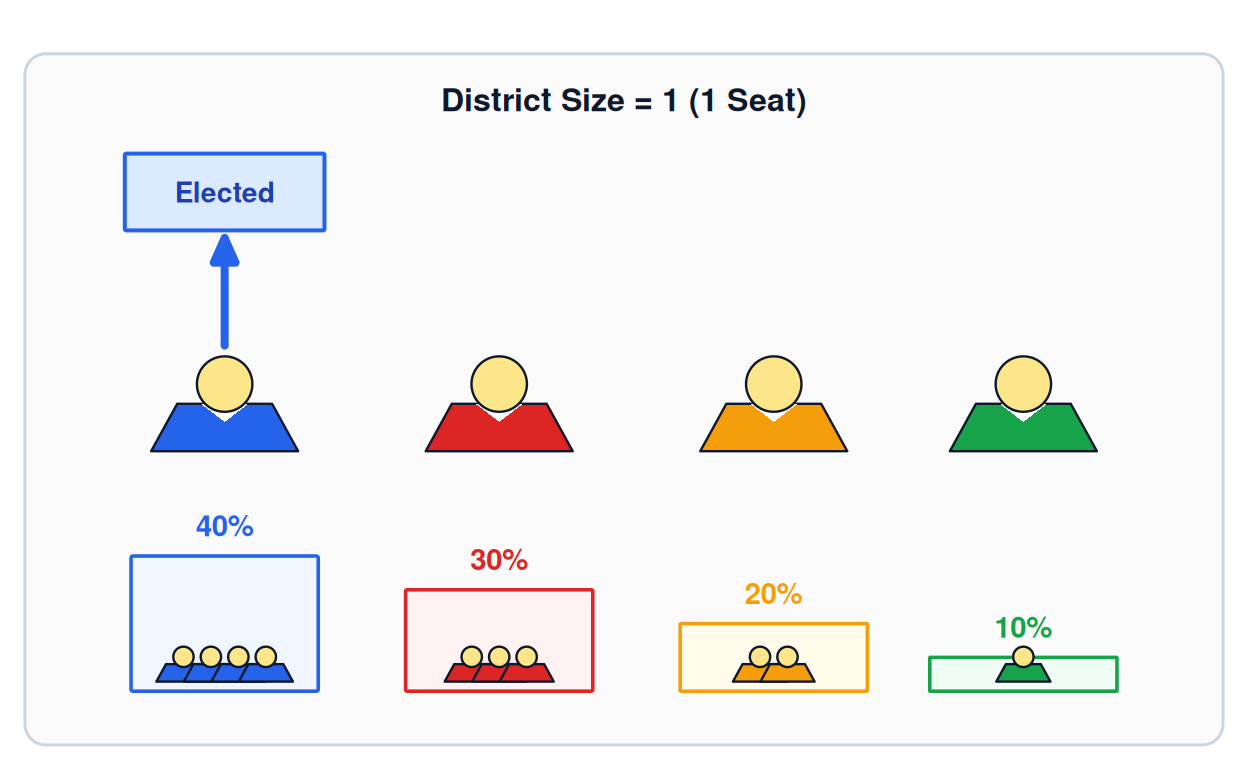
  • A single vote for a candidate in a single-member district
  • The candidate with the most votes (plurality) is elected
  • Also called “First-past-the-post”

Single-Member District Plurality System

Advantages

  • Simplicity \(\rightarrow\) straightforward for voters to understand where their vote goes
    • The importance of simplicity should not be underestimated
    • Clear rules make clear choices
  • One representative per district \(\implies\) stronger accountability
    • Easy to attribute responsibility
    • Representatives work for “their” voters

Criticisms

  • Low district-level representation \(\rightarrow\) only the “largest minority” has its candidate elected
    • E.g., only the largest ethnic group in the district is represented
  • Low national-level representation \(\rightarrow\) a minority party voted in every district can win 0 seats
    • Favors large parties at the expense of small parties with dispersed voters

Strategic Voting

SMDP encourages strategic voting
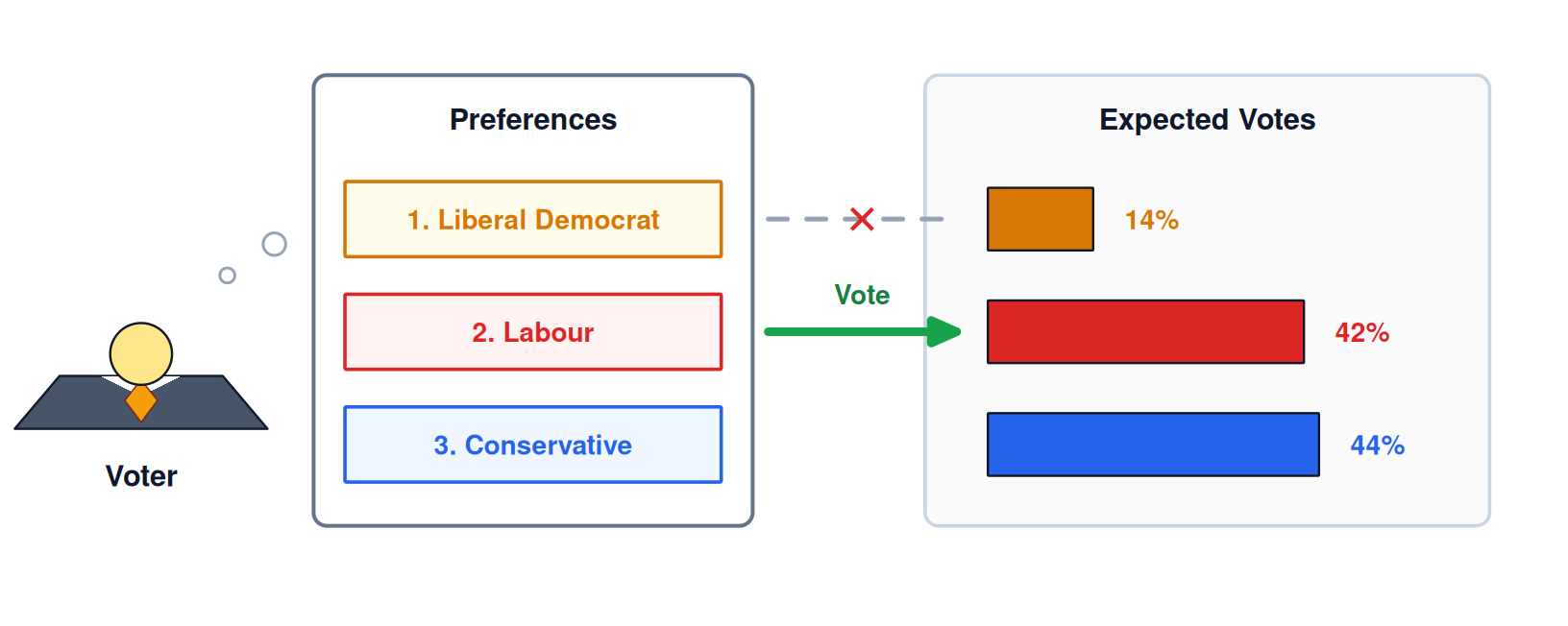
  • A vote for a candidate with no chance of winning a plurality is “wasted”
  • You may want to vote for the “best” candidate who has a chance of winning
  • In SMDP, strategic voting can be more salient than sincere voting

Single Nontransferable Vote
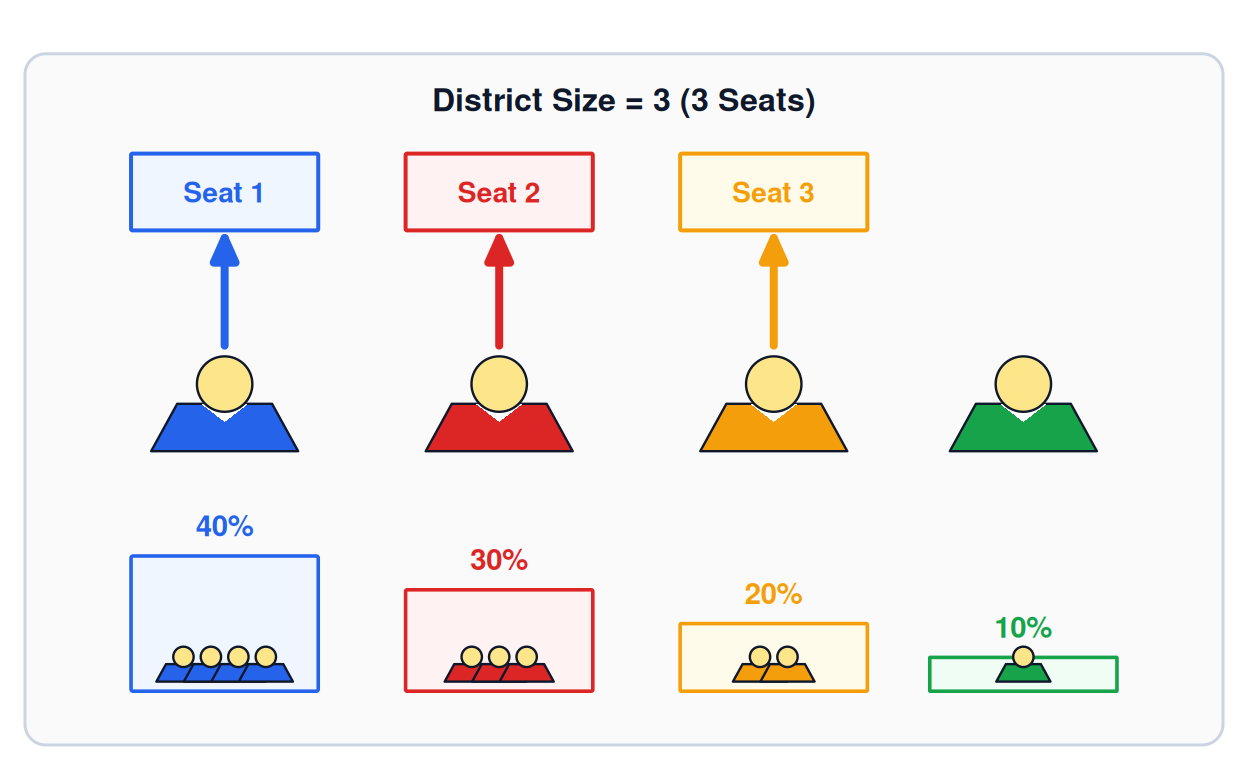
  • “Extension” of SMDP to multimember districts
  • Parties present lists of candidates, voters vote for one of them

Single Nontransferable Vote

Advantages

  • More proportionality relative to SMDP

  • Minorities can have their representatives elected even if they are not a plurality

Criticisms

  • More factionalism \(\rightarrow\) intraparty competition too

  • Personalistic competition + smaller groups of voters needed for election \(\implies\) targeted vote-buying instead of programmatic appeals

  • Fewer votes needed to win \(\implies\) less need to moderate, more extremism

Alternative Vote

Several names: Alternative Vote, Instant-Runoff Voting, Ranked-Choice Voting
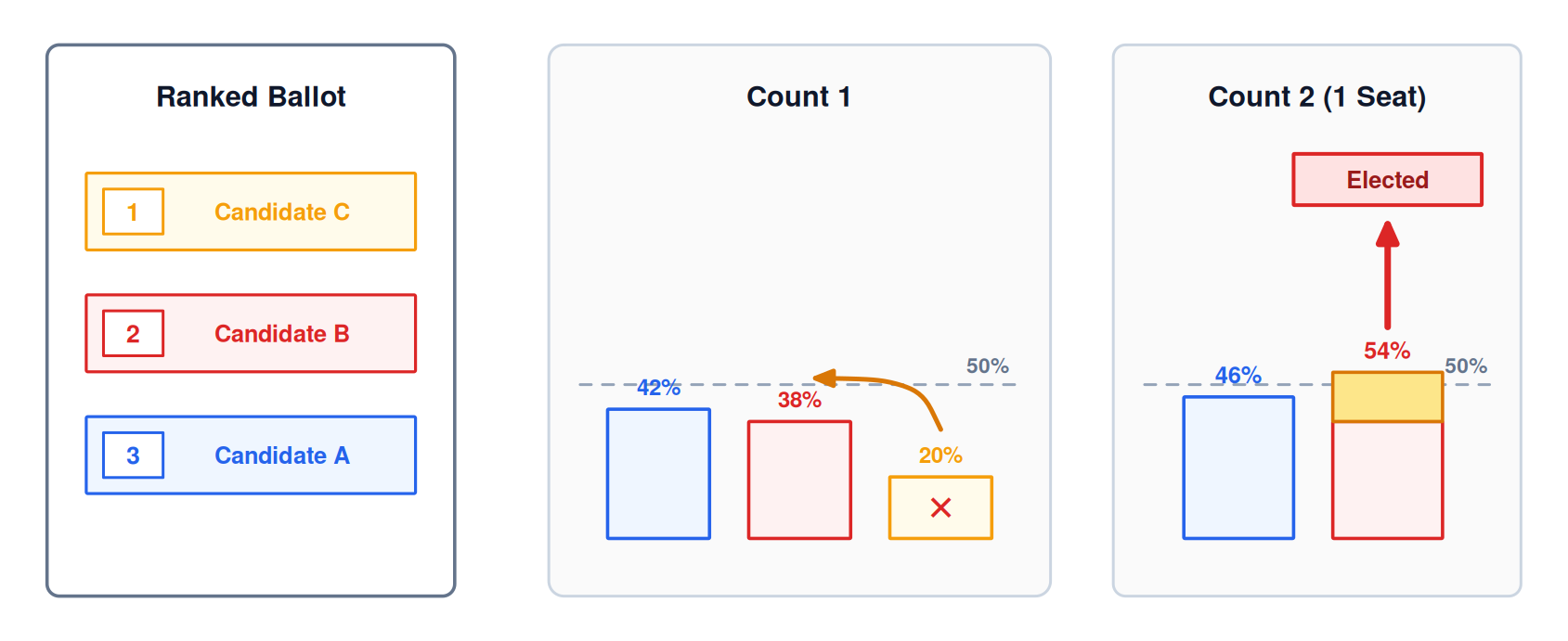
  • Voters rank candidates by preference
  • The candidate with the fewest first preferences is eliminated
  • The remaining candidates get the second preferences of his/her voters

Alternative Vote

Advantages

  • Retains the advantages of SMDP for accountability \(\rightarrow\) one representative per district

  • Voters use their full preferences \(\rightarrow\) fewer incentives for strategic voting

  • Candidates need to rank high for many people \(\rightarrow\) broader appeals + between-party bargaining

  • The winner is supported by a majority

Criticisms

  • Complex \(\rightarrow\) voter error is more likely

  • Burdensome for voters \(\rightarrow\) ranking candidates requires a lot of information

  • Relative position in the rankings (not just general “popularity”) matters

Majority-Runoff Two-Round System

Very common for electing presidents
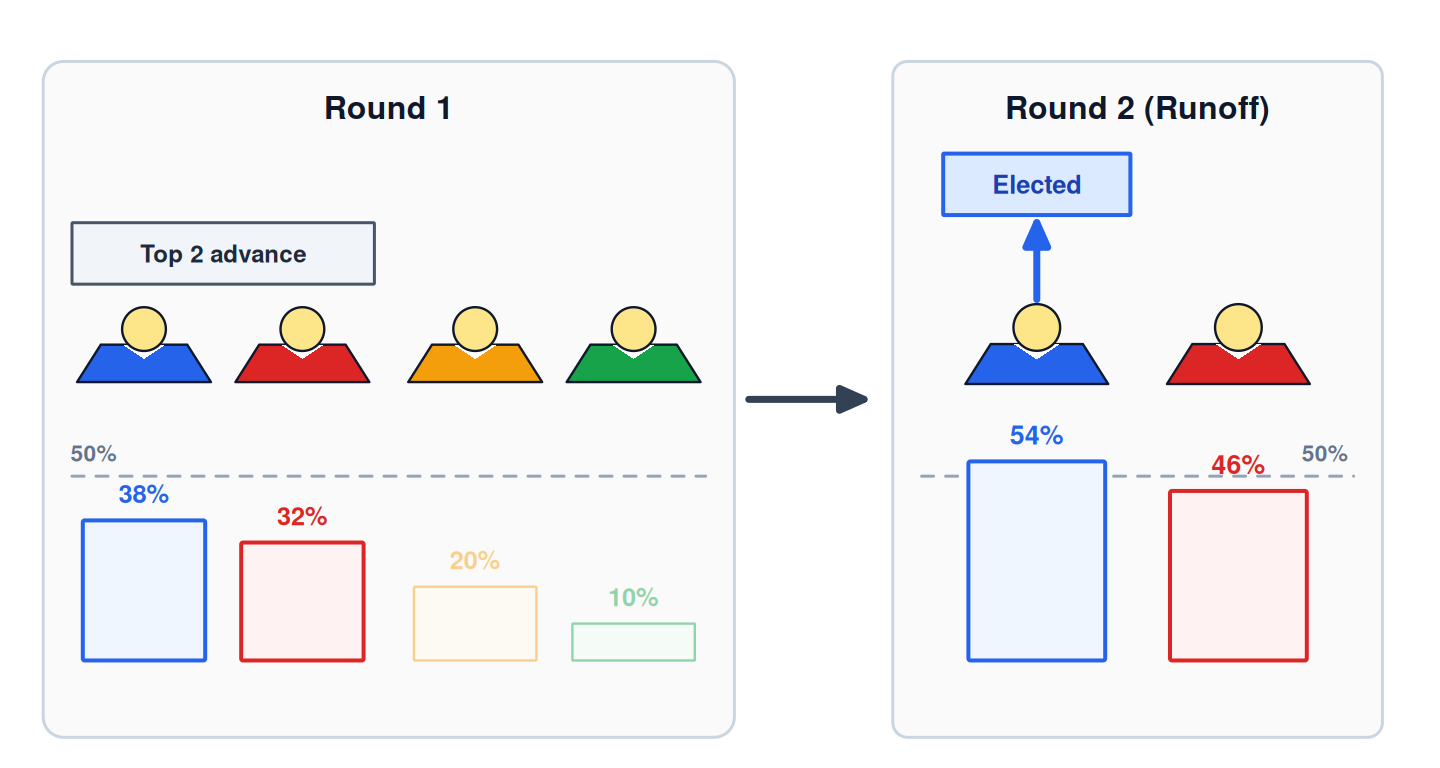
  • If a candidate wins a majority in the first round, they win
  • If not, the top two candidates advance to the second round

Majority-Runoff Two-Round System

Advantages

  • Voters have more opportunities to influence the outcome

    • E.g., vote sincerely in the first round and strategically in the second
  • Voters can change their minds between rounds

  • In the second round, candidates need to attract other candidates’ voters \(\rightarrow\) moderation

  • The winner is supported by a majority

Criticisms

  • Costly for the electoral administration and for voters
    • \(\Downarrow\) turnout in the second round
  • Very disproportional

Proportional Electoral Systems

Proportional Systems: General Characteristics

Proportional systems aim to ensure proportionality between votes and seats

  • They favor broad representation of social groups and interests

  • Typically advocated for multiethnic societies where minority exclusion can threaten peace

  • Main criticisms: fragmentation, instability, and accountability

    • PR reproduces social divisions without clear incentives for cooperation
    • Coalition governments are more unstable and responsibility is diluted
    • Greater chances for fringe or extremist parties

List PR Systems

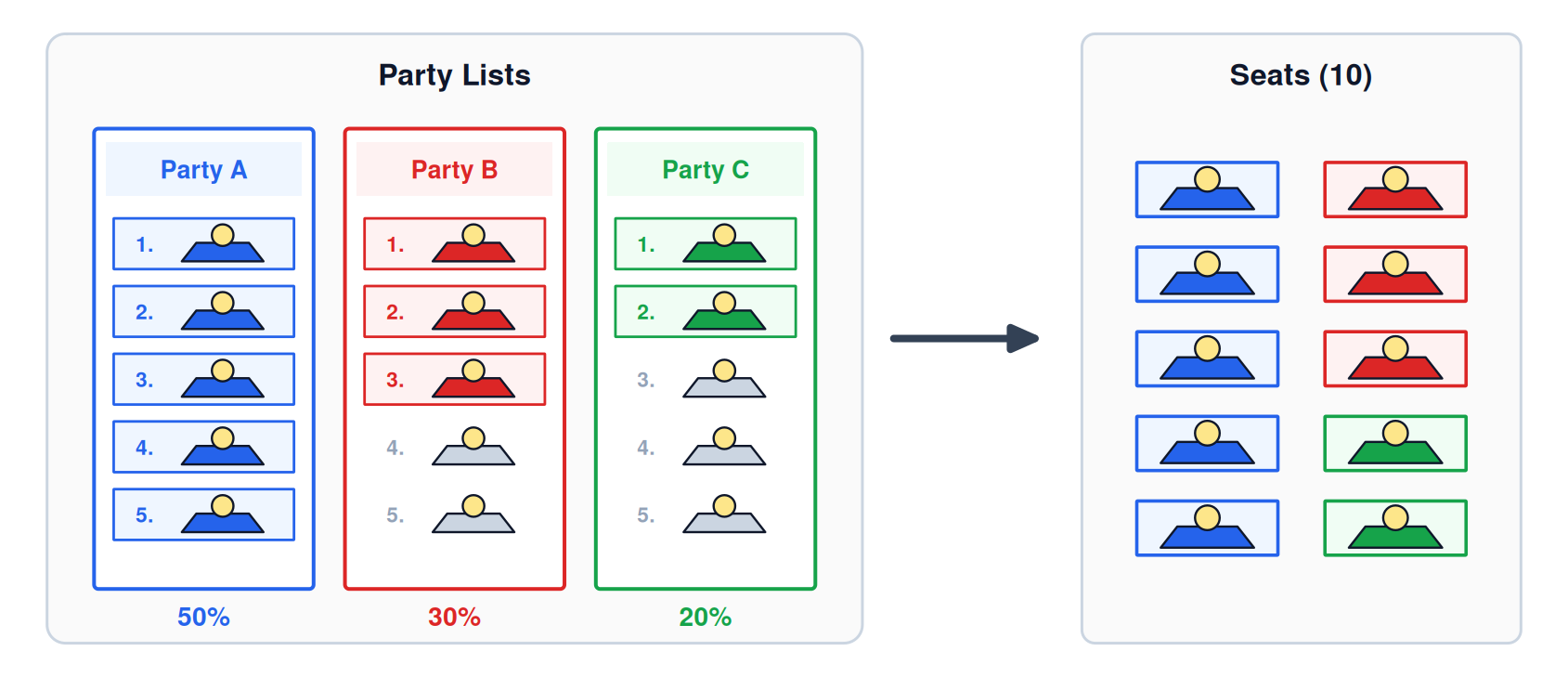
  • Parties present lists of candidates in multimember districts
  • Seats are allocated in proportion to the votes cast for the list
  • Differences in the “details” of the system are key

Important Concepts: District Magnitude

District magnitude \(\rightarrow\) n. of candidates elected in a district

  • The most important factor influencing the proportionality of a system

  • Extreme case: a single nationwide list

    • E.g., the Netherlands, Israel, and European Parliament elections in many countries
  • The larger the magnitude, the less direct the link between voters and representatives

Important Concepts: Electoral Thresholds

Electoral threshold \(\rightarrow\) minimum % of votes a party needs to enter parliament

  • A natural threshold is implicit \(\rightarrow\) when the number of seats is small, some parties are inevitably excluded

  • Formal thresholds are used to reduce party fragmentation

  • High thresholds decrease representation and re-introduce strategic voting

Important Concepts: Type of List

Types of party lists \(\rightarrow\) determine which candidates from the list are elected

Closed List

  • Who is elected depends on the position on the list
  • If a party wins \(n\) seats, they go to the first \(n\) candidates
  • Gives parties full control over candidates
    • Less personalistic system
    • Can introduce quotas or minority candidates

South African Closed List ballot paper (1994) (Source: Minnekon - Wikimedia Commons)

Important Concepts: Type of List

Types of party lists \(\rightarrow\) determine which candidates from the list are elected

Open List

  • Voters vote for the list and for candidates within the list
  • Seats won by the list are allocated based on the number of personal votes instead of list order
    • More choice for voters, but at the cost of greater complexity
    • Re-introduces the personal vote

Danish Open List ballot paper (2019) (Source: Minnekon - Wikimedia Commons)

Single Transferable Vote

The only PR system without lists
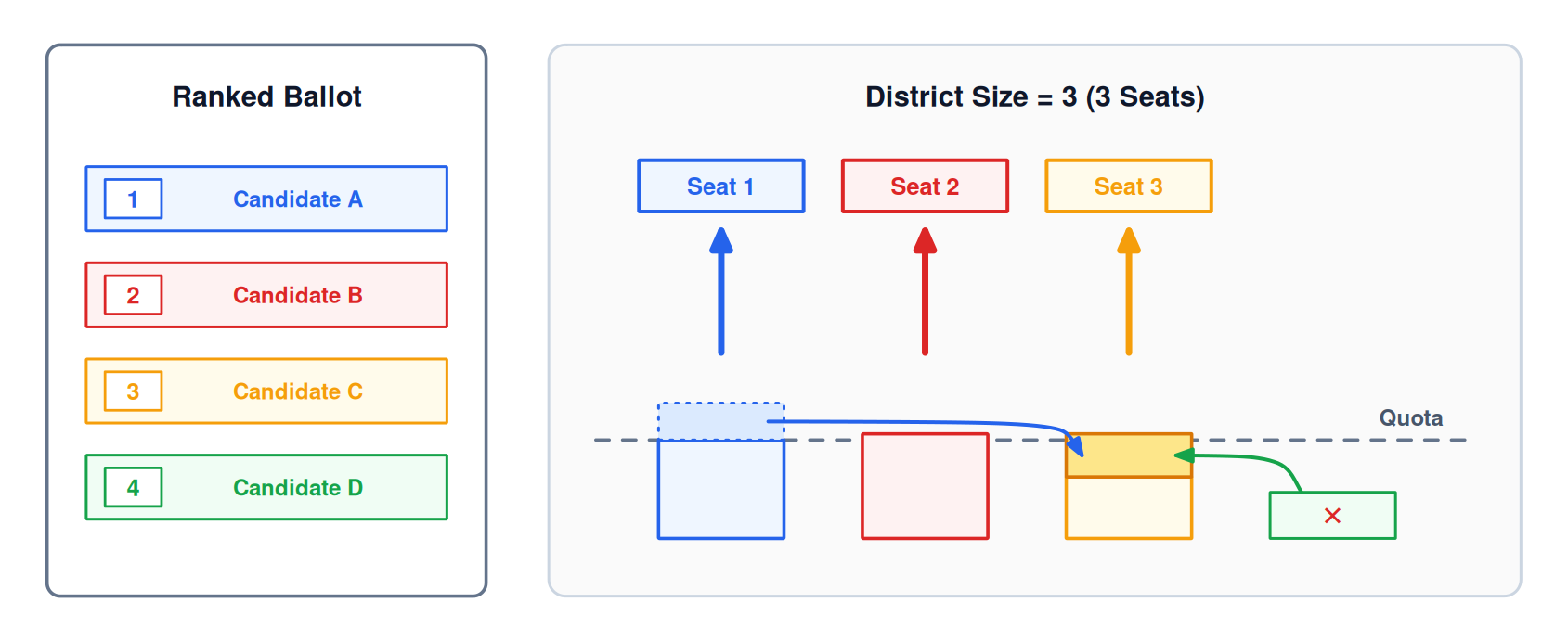
  • Similar to AV in multimember districts
  • Voters rank candidates
  • Candidates who reach a certain quota of votes are elected

Single Transferable Vote

The only PR system without lists
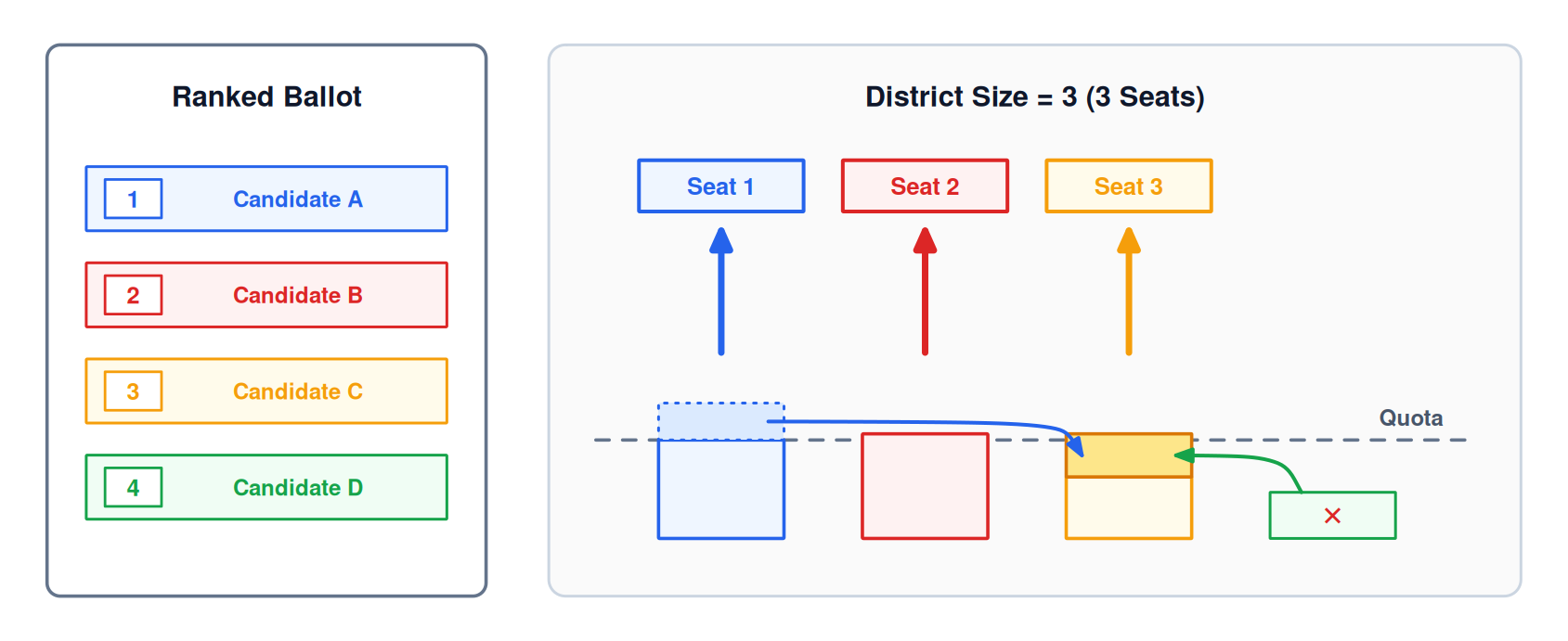
  • At each step, the candidate with the fewest votes is eliminated
  • Votes for eliminated candidates and surplus votes for elected candidates are transferred to other candidates based on ranked choices

Single Transferable Vote

Advantages

  • Maintains the advantages of AV in terms of voter choice while being proportional

  • More control over candidate choice than list PR

  • Typically allows cross-party voting \(\rightarrow\) not the case in most list PR

Criticisms

  • All the criticisms of candidate-centered systems
    • Personalism, intraparty factionalism
  • \(\Uparrow\) number of candidates to rank
    • Even more difficult for voters to make an informed choice
    • Lower district magnitude mitigates the problem but reduces proportionality too

Mixed Electoral Systems

Mixed Electoral Systems

Seats are allocated under both majoritarian and proportional systems

  • Voters have two votes
  • Typically multiple electoral tiers
    • Majoritarian seats in low-level districts with small magnitude
    • Proportional seats in high-level constituencies (regional or national)

New Zealand ballot paper (1993 – sample)

Mixed Electoral Systems

Advantages

  • Combines the appealing features of both systems

  • PROP \(\implies\) proportional outcomes and social representation

  • MAJ \(\implies\) territorial representation and direct accountability

Criticisms

  • Two different classes of legislators with different “loyalties” (parties vs. voters)

  • Low cohesion

  • May be difficult for voters to understand the aggregation of votes

Summing Up

What We Learned

  • Electoral systems are “the rules of the game” of how political power is distributed

  • Different rules imply different choices and strategies for voters

  • Choosing an ES implies trade-offs

  • Majoritarian systems favor clear majorities and accountability

    • But lower representation for some social groups
  • Proportional systems favor broad representation

    • But more fragmented and potentially unstable governments

Important Takeaways

  • Voters always weigh sincere and strategic voting considerations

  • The electoral system makes one or the other more relevant

  • This has a key implication for the study of politics: \(\implies\) we generally cannot infer what voters would do under one electoral system from their behavior under another

  • E.g., “If the UK adopted list PR, Labour would win more votes in these areas”

    • Perhaps, but many voters would change their vote
    • Knowing this, new parties would have an incentive to emerge
    • So everything would change
  • Next week, we will see that the number of parties also depends on the electoral system

Thank you!