7. Parliamentary, Presidential, and Semi-Presidential Democracies

Comparative Politics

Giacomo Lemoli

Motivation

Donald Trump (Source: whitehouse.gov)

Joe Biden (Source: whitehouse.gov)

Keir Starmer (Source: Simon Dawson)

Friedrich Merz (Source: Steffen Prößdorf)
  • The first two only need to worry every 4 years
  • The second two have to worry pretty much all the time

Our Plan for Today

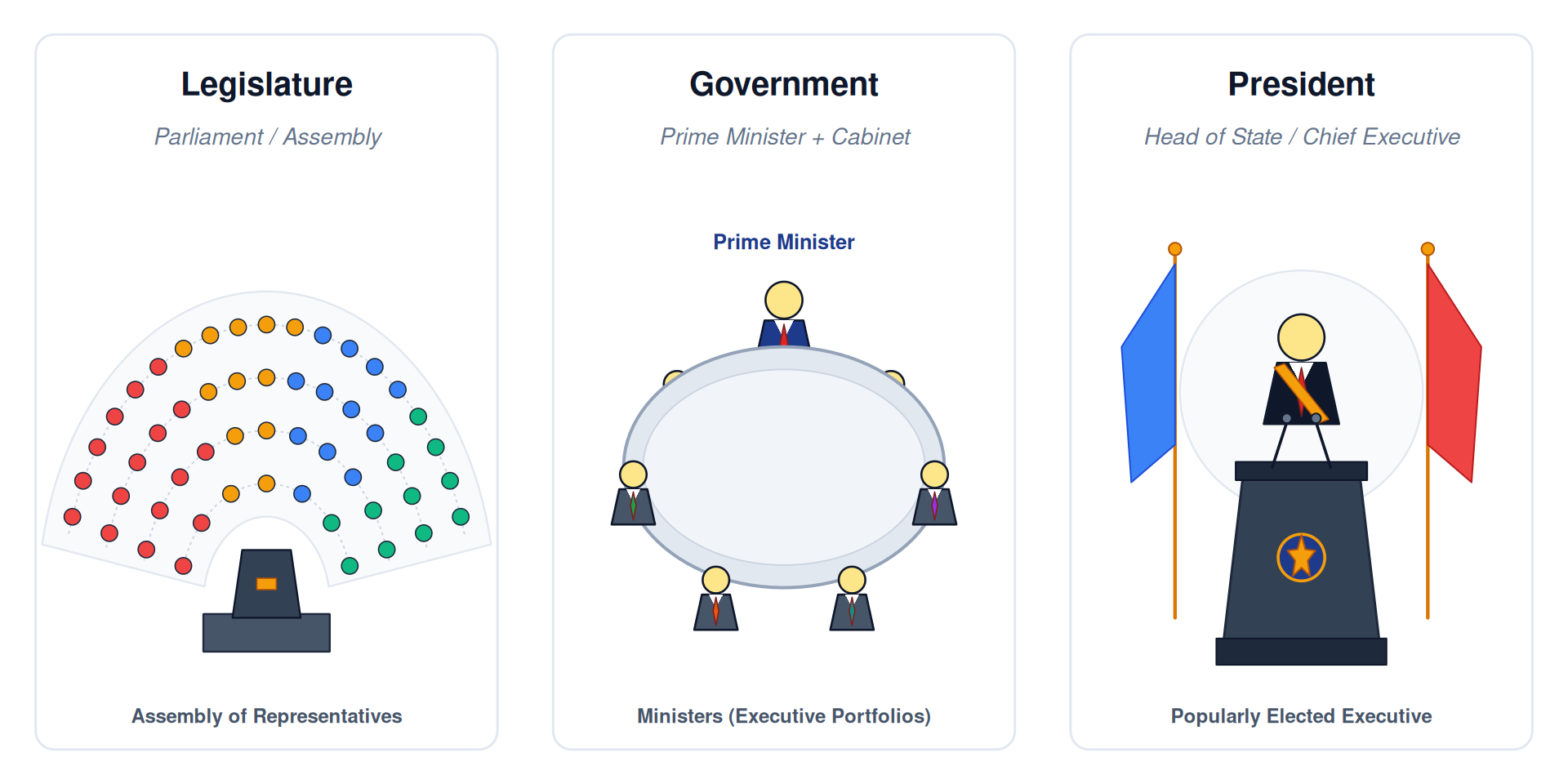
Democratic governments (the executive branch)

Classification of democracies

  • Based on who selects and “controls” the government
  • Parliamentary democracy \(\rightarrow\) responsibility to legislature
  • Presidential democracy \(\rightarrow\) autonomy from legislature
  • Semi-Presidential democracy \(\rightarrow\) “mixed” form

Government formation and survival under each type

  • Who forms the government
  • How are powers distributed
  • How can the government be dismissed

Actors

Classifying Democracies

Criteria for Classification

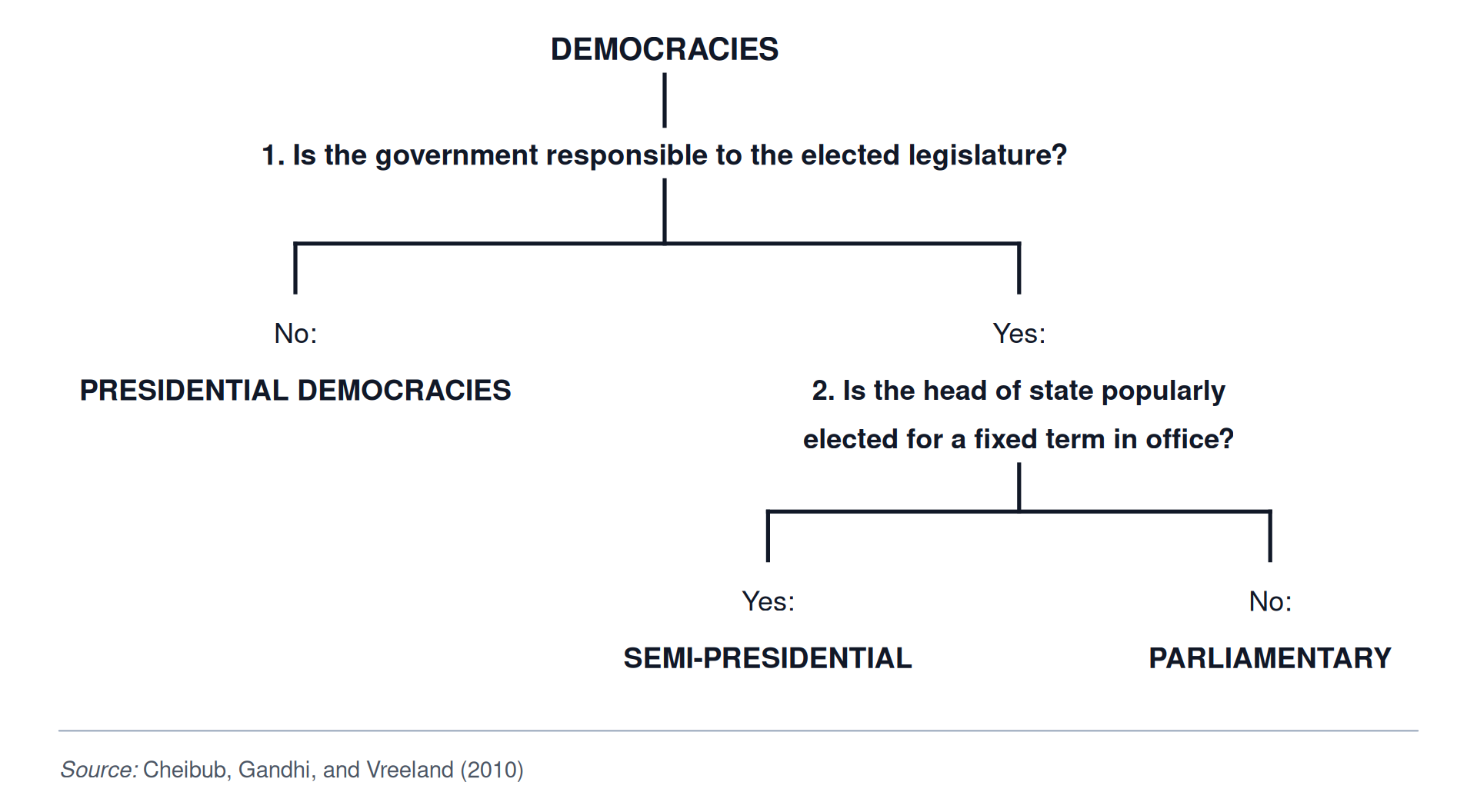
Is a democracy presidential, parliamentary, or semi-presidential? It depends on

  1. Responsibility of the government to the legislature
  • Parl/Semi-Pres: legislature has constitutional power to remove the government without cause
  • Removed if no confidence vote won by a majority
  • Pres: legislature cannot remove the government without cause
  1. A popularly elected head of state serves a fixed term in office
  • Either “direct” or “indirect” vote, e.g., Electoral College
  • Parl: HoS not popularly elected, mostly ceremonial role (including Kings)

Classifying Democracies

Governments in Parliamentary Democracies

The Government

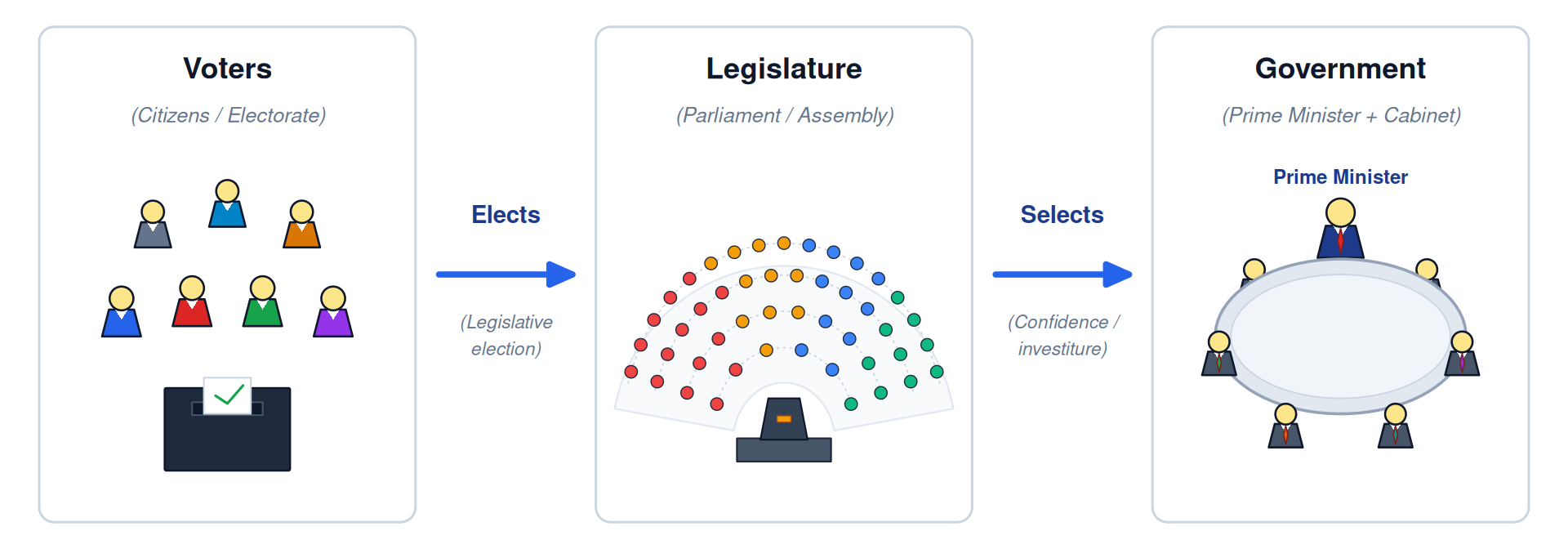
Government: Prime Minister (chief executive) + Cabinet

  • Cabinet: Ministers in charge of policy areas
  • Bear collective responsibility for the government’s decisions

Government Formation: The Need for Coalitions
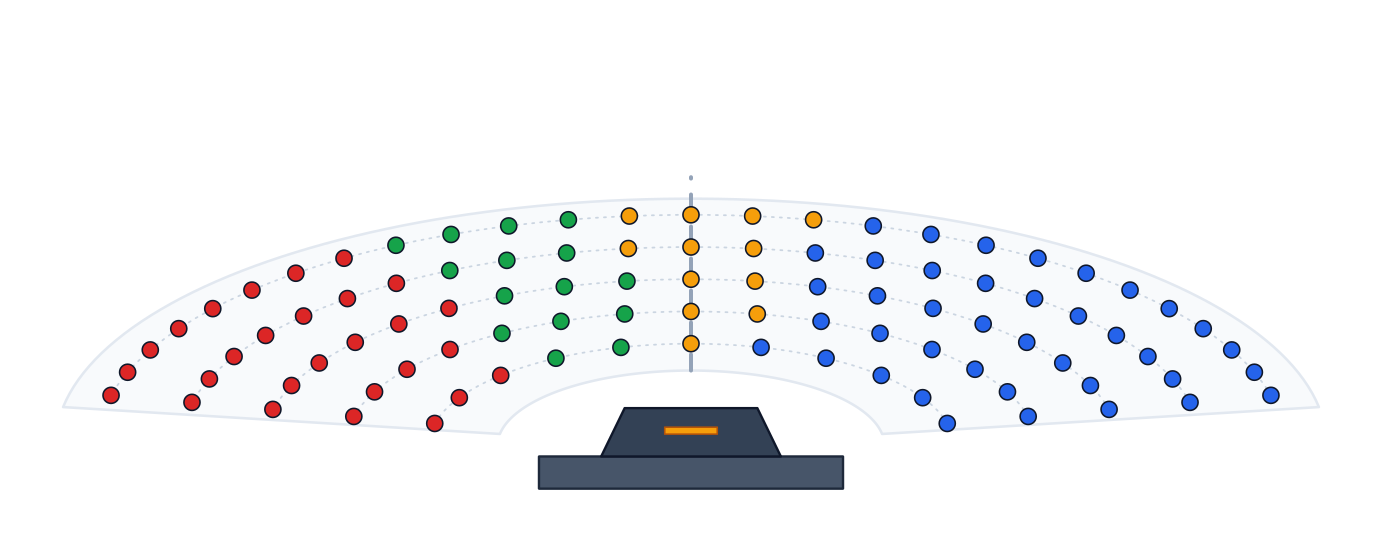
  • The government must enjoy support from a majority in the legislature
  • Threat of no confidence vote
  • A party has a majority of seats \(\rightarrow\) can govern alone
  • No party has a majority of seats \(\rightarrow\) a coalition must be formed

Government Formation and Dissolution Process

Government Formation Process

  • Party leaders bargain over possible coalitions (next slides)
  • “Supervision” role of the HoS (effective influence varies by country)
  • Bargaining led by a “formateur”, typically the largest party’s leader (likely PM)
  • PM appoints cabinet members \(\rightarrow\) cabinet posts at the center of the bargaining process

Government Dissolution Process

  • Once formed, the govt stays until the next election or a no confidence vote
  • If it loses confidence, it remains in power until a new one is formed (early election or new coalition)

Theory of Government Formation

What explains government formation?

\(\implies\) We want to isolate the key forces that drive the bargaining process

  1. Office-seeking incentives \(\rightarrow\) office concessions
  • MPs care about office (cabinet portfolios), that’s their condition for support
  • Larger parties want more portfolios
  • Pull towards a Minimal Winning Coalition: smallest possible majority
  1. Policy-seeking incentives \(\rightarrow\) policy concessions
  • MPs have ideological motivations, want their policies implemented
  • Larger parties want more leverage in government policy
  • Pull towards a connected coalition: parties ideologically close

Office vs Policy

  • Both incentives are present
  • Democratic competition forces politicians to pursue both
    • They need office to deliver what they promised to voters
    • They need to deliver what they promised if they want to stay in office
  • Office has both intrinsic and instrumental value to politicians
  • Even if purely office-seeking, they are forced to behave as if they were policy-seeking
  • Even if purely policy-seeking, they are forced to behave as if they were office-seeking
  • This entails trade-offs, e.g., what govt coalition to enter

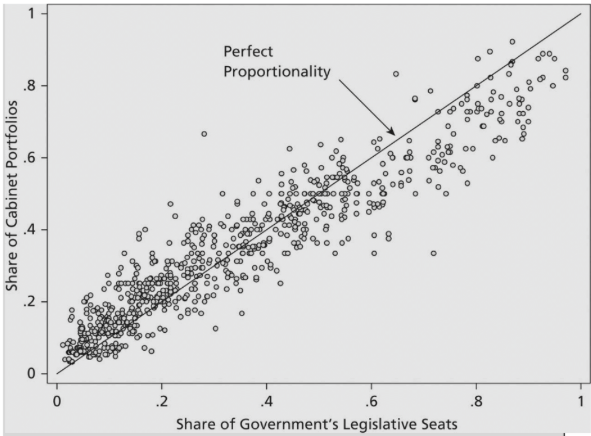
Gamson’s Law

Larger parties in the legislature get larger quotas in the government
Types of Government

Majority governments

  • Single Party Majority: one party has majority of seats
  • Minimal Winning Coalition: smallest possible majority
  • Surplus majority: larger majority than strictly necessary
    • “National unity” governments to implement important policies
    • Avoid “veto threat” by small parties in MWC or “commitment problem” of coalition partners

Minority governments

  • Single Party Minority or Minority Coalition
  • Opposition “tolerates” the government, which is under constant threat
  • Influence policy with less accountability or avoid “uneasy” coalitions

Governments in Presidential Democracies

The Government

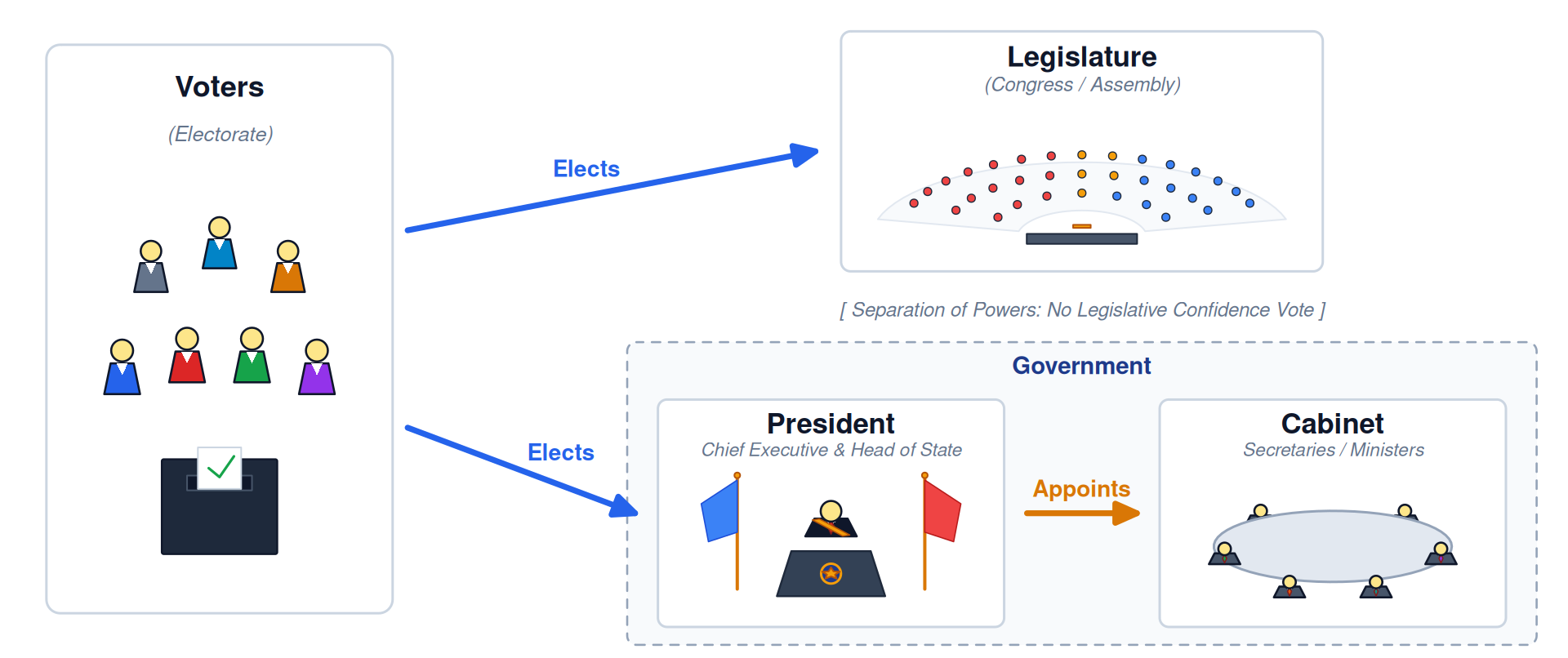
Government: President (Chief Executive and Head of State) + Cabinet

  • The President is always the “formateur”, and their party is automatically included in the cabinet
  • No responsibility to the legislature \(\rightarrow\) Govt is replaced at fixed intervals

Types of Government

In a Pres. system the logic of coalition formation bargaining breaks down

  • The President can appoint co-party members even if the party has a minority of seats
  • \(\Uparrow\) Minority cabinets, \(\Downarrow\) coalition cabinets
  • However, coalition cabinets remain common
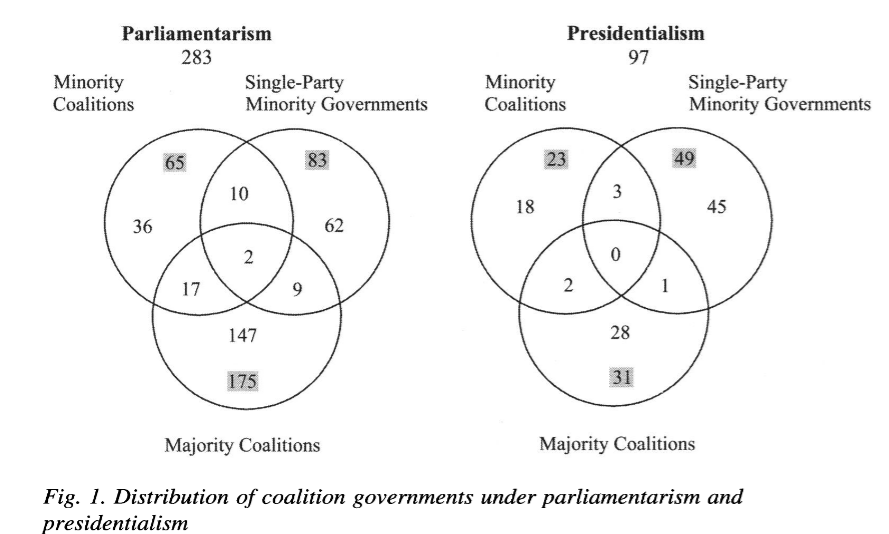
Cheibub, Przeworski, Saiegh (2004)

A President still needs a legislative majority to pass laws \(\implies\) coalition government may be needed to get things done

More limited legislative powers of the Pres. \(\implies\) cabinet proportionality

Governments in Semi-Presidential Democracies

The Government

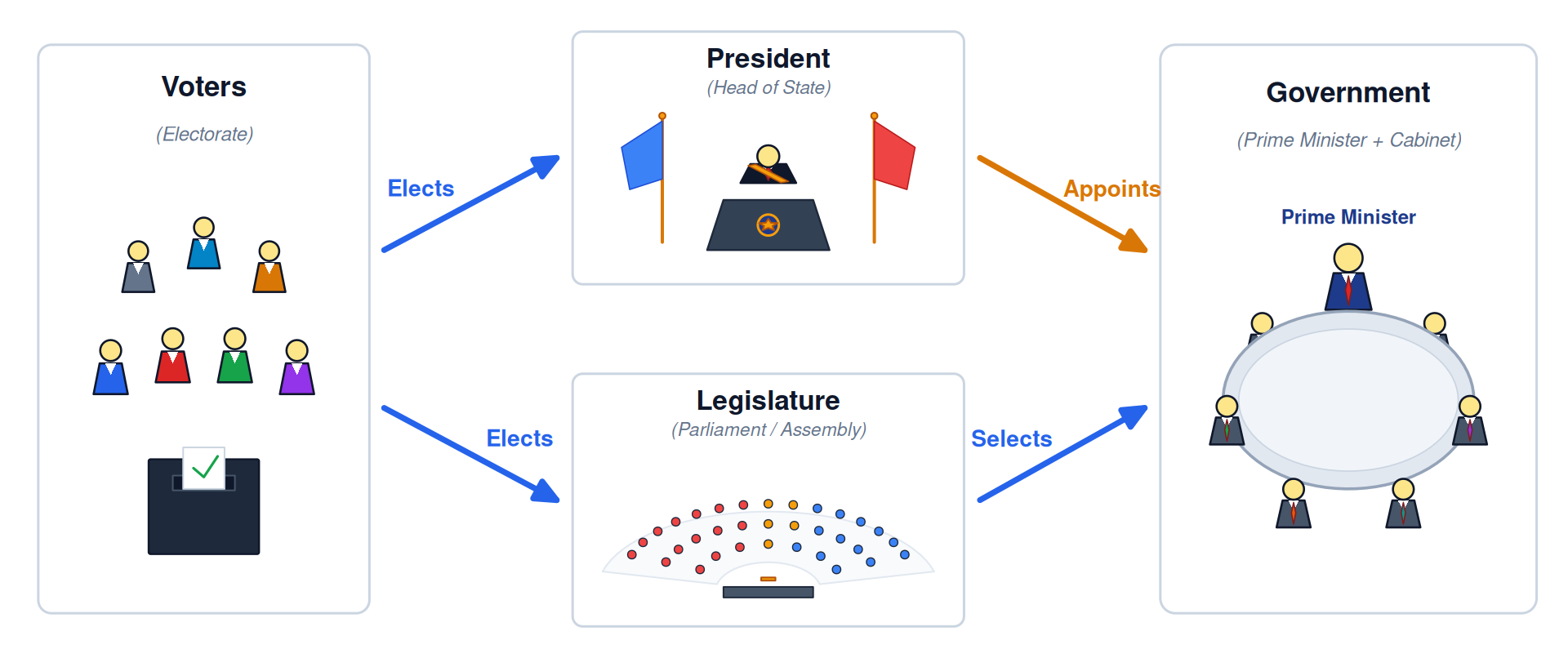
Government: Prime Minister + Cabinet (+ President)

  • The government can be responsible to the legislature and the President
  • Large variation in effective powers of the President

Cohabitation of Prime Minister and President

François Mitterrand

Jacques Chirac (INRA, DIST, Jean Weber)
  • The President and the PM can be from different parties \(\rightarrow\) cohabitation
  • Unlike Pres. systems, cohabitation can be unavoidable

Balance of Powers
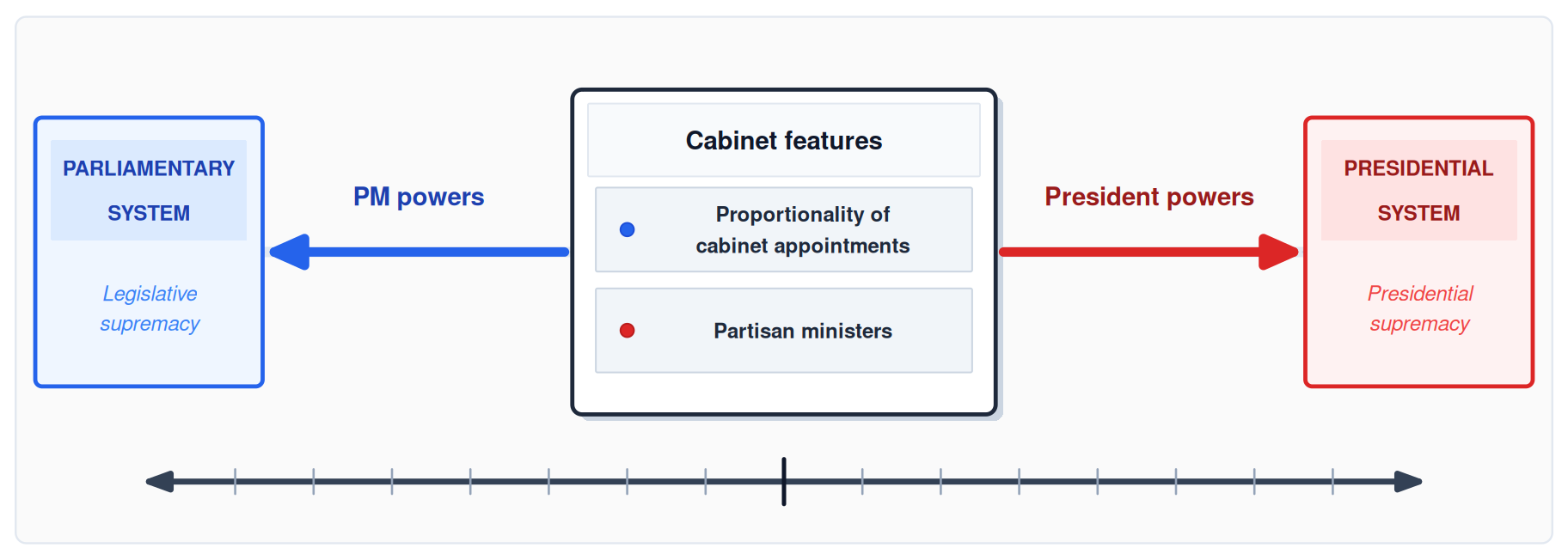
  • Semi-Presidentialism has both Pres. and Parl. features
  • The balance of powers between PM and President pulls towards one pole
  • The President is less strong than in Pres. democracy
    • The government is responsible to the legislature; the Pres. needs a majority to get their preferred policies
  • The PM is also less strong than in Parl. democracy

Summing Up

What We Learned

The types of democracy reflect different ways to structure the relationship between legislative and executive branches

  • Presidential systems \(\rightarrow\) absence of legislative responsibility
    • “Mutual independence” between executive and legislative
    • Fixed govt duration
  • Parliamentary systems \(\rightarrow\) legislature controls govt composition
    • “Mutual dependence” between executive and legislative
    • Coalition formation bargaining \(\rightarrow\) office and policy incentives
    • Govt survival determined in parliament
  • Semi-Presidential systems \(\rightarrow\) “mixed” features
    • The President can form the govt, but the govt requires a parliamentary majority

Thank you!