4. Democracy and Dictatorship: Economic Origins

Comparative Politics

Three Pictures
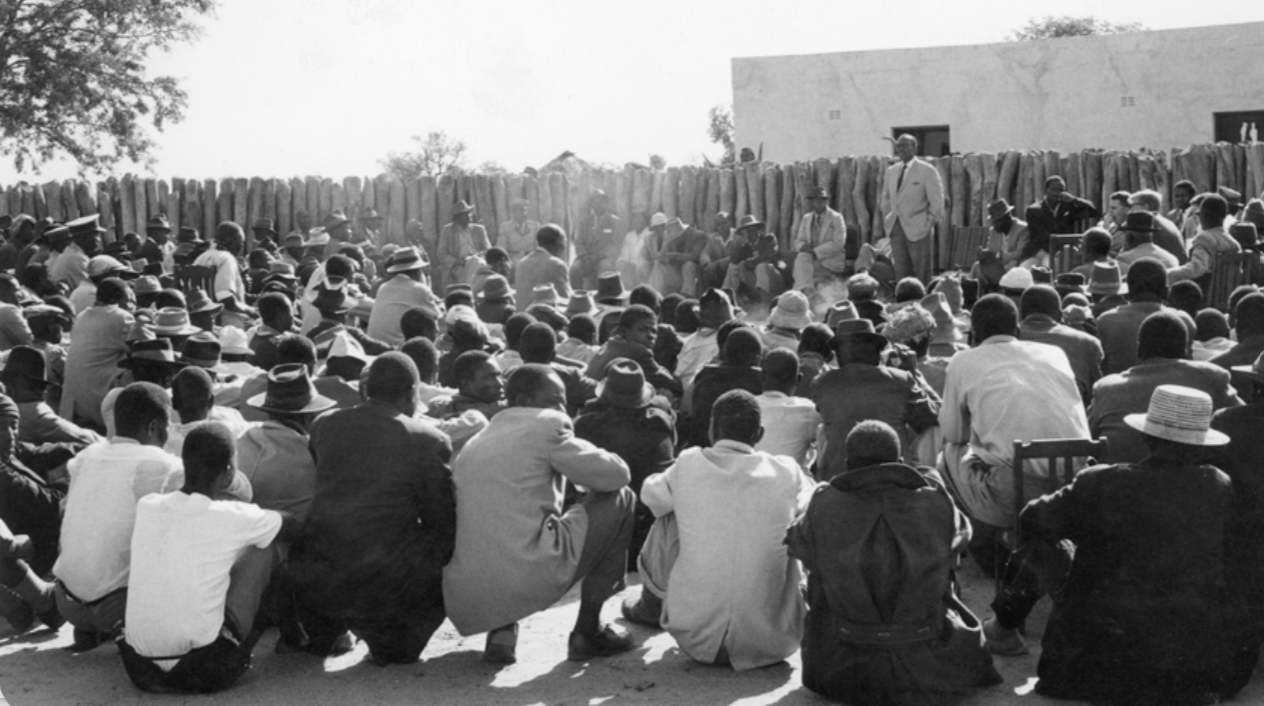
Courtesy of Julio Solís Arce

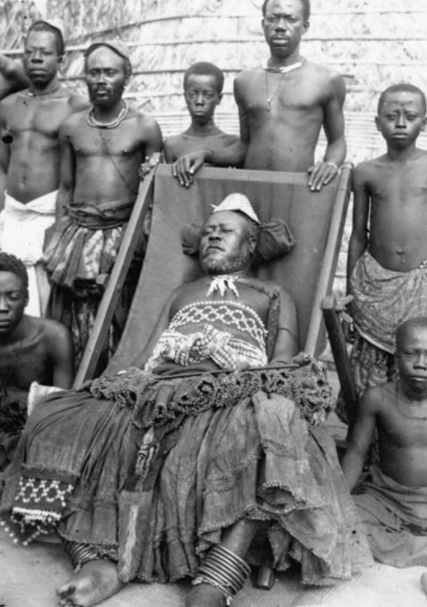
King Kweet Mabine maKyeen (Vansina 2010, p. 194)

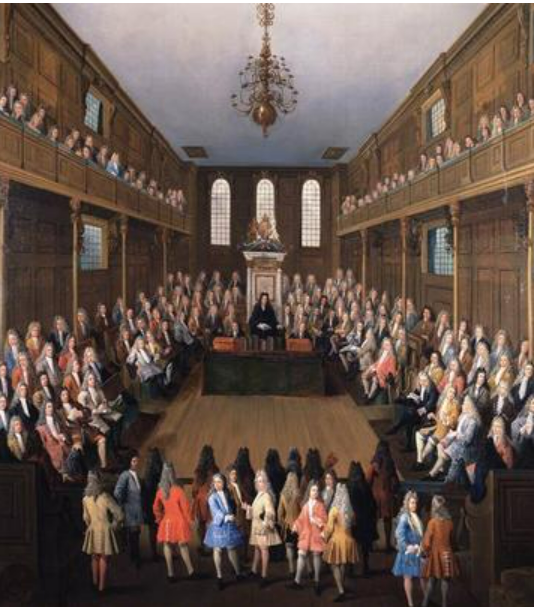
Peter Tillemans, The House of Commons in Session (1710)

Which of these pictures represents a democracy?

\(\implies\) Depending on the definition, all three or none

A Different Picture
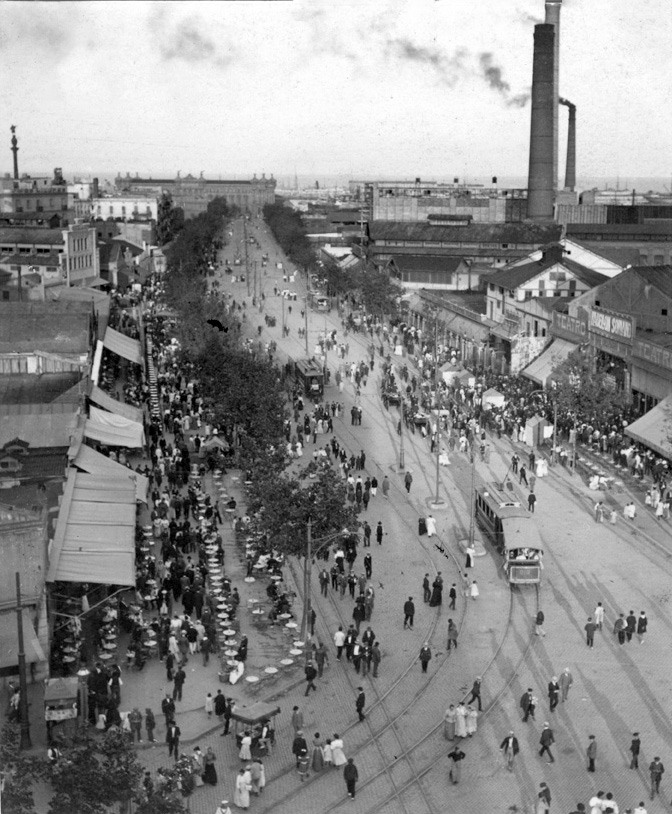
Source: Federico Ballell Maymí - Arxiu Fotogràfic de Barcelona, Wikimedia Commons

Does modernization lead to democracy?

\(\implies\) It depends

Q1: What is Democracy?

What is democracy? What makes a country a democracy?

  • Many intuitive concepts are invoked
    • The government is constrained, the people decide, power is shared…
  • Principles adopted by many human societies since antiquity
  • Our understanding and definition of democracy has evolved over time

Q2: Does Development cause Democracy?

  • Intuitively we think of prosperity and democracy as connected
  • As a static relationship it seems reasonable
    • 9 of top 10 countries by GDP p.c. are democracies
  • But is there a dynamic: development \(\implies\) democracy?
    • Even intuitively, much less obvious
  • A scientific approach to the question: isolate core mechanisms
    • Do development alter state-society relationships?
    • If yes, how can this lead to democracy?

Our Plan for Today

Democracy: definitions and change

  • Early vs Modern democracy: from consent to representation
  • The value of elections
  • Constraining the government vs participation

Development and Democracy \(\rightarrow\) Modernization theory

  • Economic change and the rise of the bourgeoisie
  • The commitment problem of the government
  • Institutional solutions to the commitment problem
  • Conditionality of the theory

What is Democracy?

Early Democracy

Early democracy \(\rightarrow\) local rulers + council of independent community members

Village assemblies (direct democracy)

The Kuba Kingdom (early representation)
  • Rulers need consent of community members
  • Direct (all those entitled decide) or representative (selected few decide)
  • Council members \(\rightarrow\) custom or social structure (e.g., elderly, HH heads)

Modern Democracy

Modern democracy \(\rightarrow\) representatives of the people regularly chosen in competitive elections under universal suffrage

  • Representative \(\rightarrow\) a minority of selected few rules
  • Election \(\rightarrow\) people choose them
  • Regular \(\rightarrow\) chosen rulers can be renewed often
  • Competitive \(\rightarrow\) chosen rulers can indeed be renewed often
  • Universal suffrage \(\rightarrow\) \(\sim\) all adults choose

From Early to Modern Democracy

Modern democracy retains early democratic principles/procedures but changes others

Core principles

  • Rule is based on people’s consent
  • The people’s will constrains what the ruler can do

Innovations

  • The rulers compete to be chosen
  • Citizens’ participation \(\rightarrow\) elections
  • Between elections, rulers rule autonomously
  • Mass participation

Why Elections?

Why are elections so central to modern democracy?

Societies become increasingly large and complex

  • Direct democracy is infeasible \(\rightarrow\) impossible to vote on everything
    • Few leaders should decide but respecting people’s will
  • Possible conflicts increase \(\rightarrow\) more at stake in pursuing power
    • Selection of leaders should manage conflicts peacefully

Why Elections?

Regular + competitive elections provide potential solutions

  • Power alternation \(\rightarrow\) today’s losers can still win tomorrow
  • Losing power is no longer an existential threat
  • Pushes winners to moderation and losers to democratic commitment
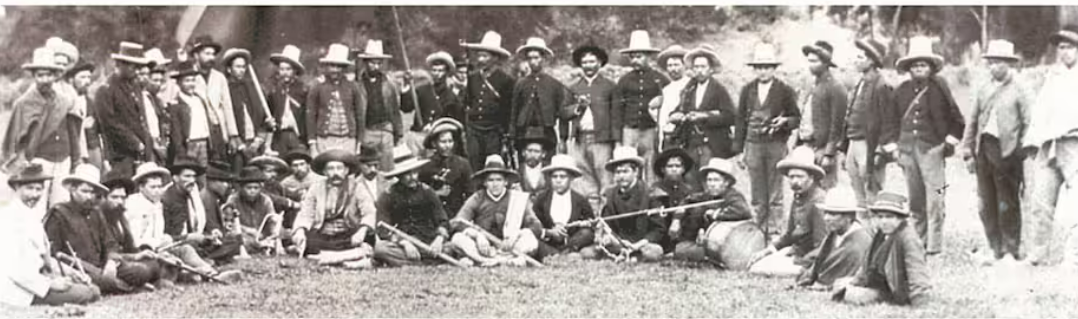
Militias of the Conservative Party in Colombia (Source: Quintilio Gavasa/El Espectador)
  • Accountability of rulers \(\rightarrow\) future power depends on performance
  • Rulers anticipate the future evaluation of voters
  • Pushes policies to (perceived) will of the people
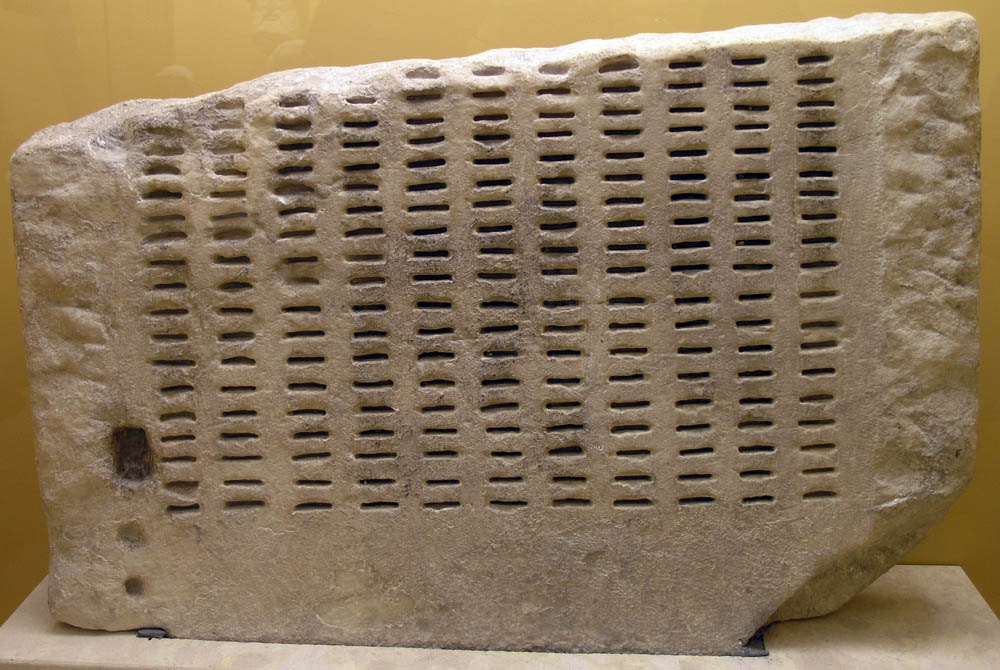
Kleroterion (Source: By Marsyas/Wikimedia Commons

Historical Trajectories

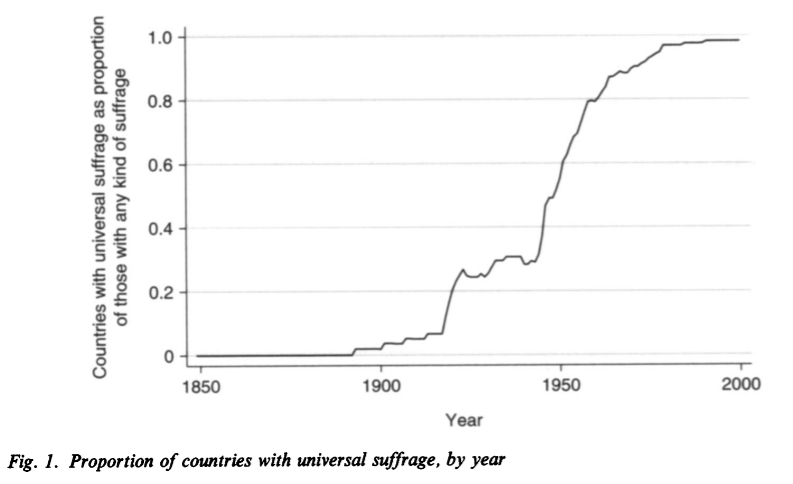
Modern democracy was not created overnight but evolved
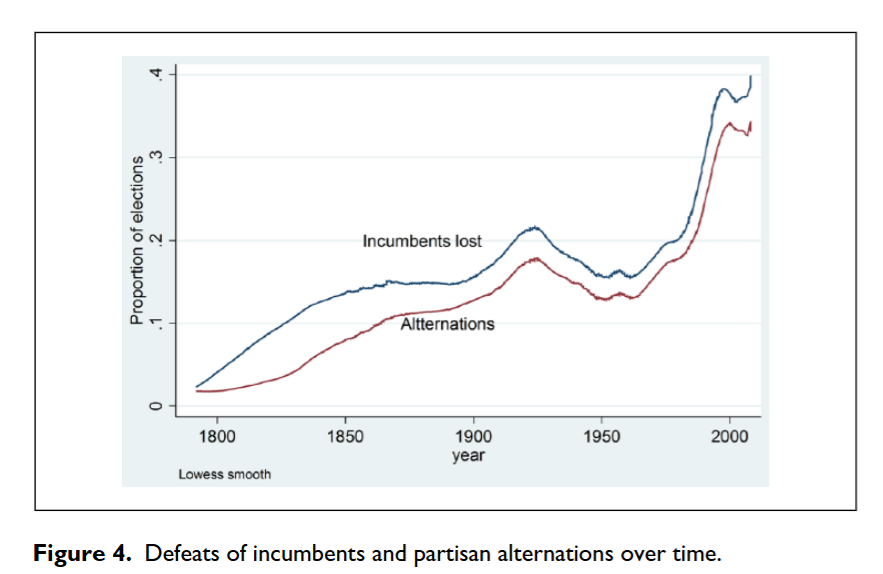
Source: Przeworski (CPS 2015)

Source: Przeworski (BJPS 2009)
  • Alternation initially low \(\rightarrow\) rulers reluctant to cede power
  • Accountability initially an elite game \(\rightarrow\) universal suffrage comes later

Elections in the World
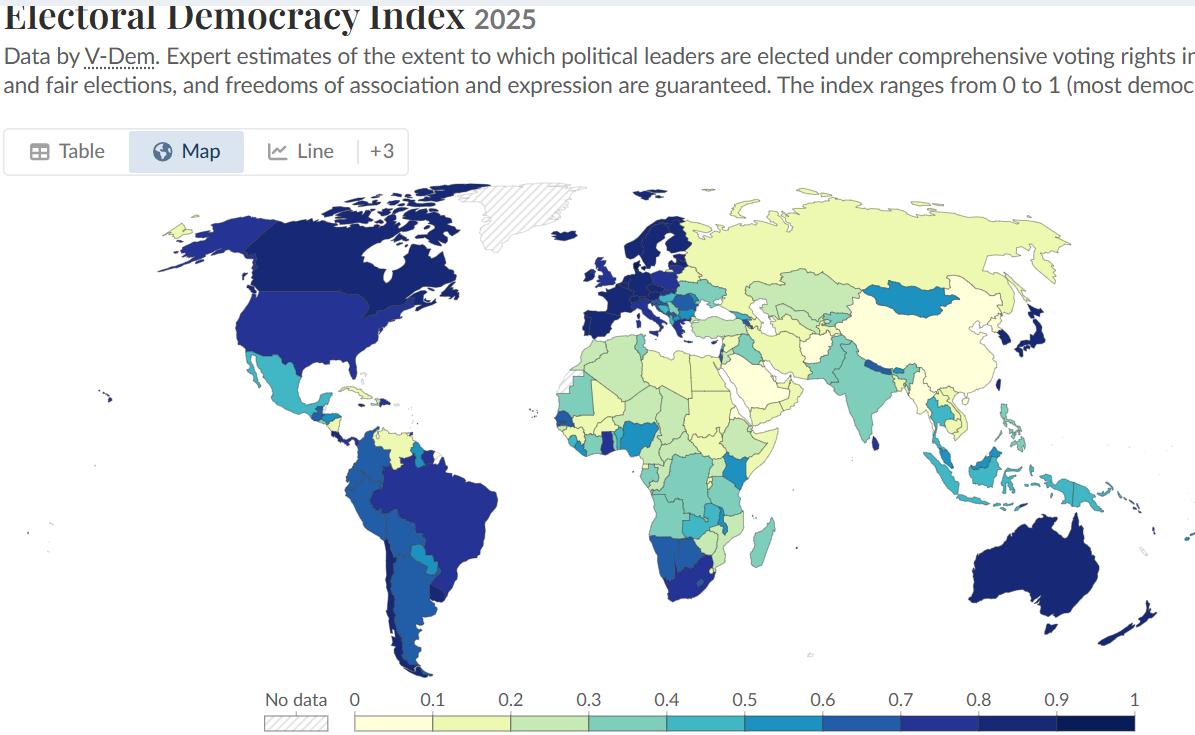
Source: V-Dem/Our world in data

  • Why did many countries democratize while many others didn’t?
  • Is there a link between development and democracy?

Development and Democracy

The Modernization Theory

Modernization Theory

Economic development \(\implies\) Democratization

By development we typically mean

Large agricultural sector
Small industrial sector
Small service sector
Population mostly rural
Low education levels

\(\Longrightarrow\)
\(\Longrightarrow\)
\(\Longrightarrow\)
\(\Longrightarrow\)
\(\Longrightarrow\)

Small agricultural sector
Large industrial sector
Large service sector
Urbanization
High education levels

Step Zero: Selecting Core Mechanisms

Why should development lead to democracy?

Recall the predatory view of the state:

Agriculture \(\implies\) Low mobility + Legibility \(\implies\) Power concentration

\(\implies\) how does transitioning away from agriculture alter power balance?

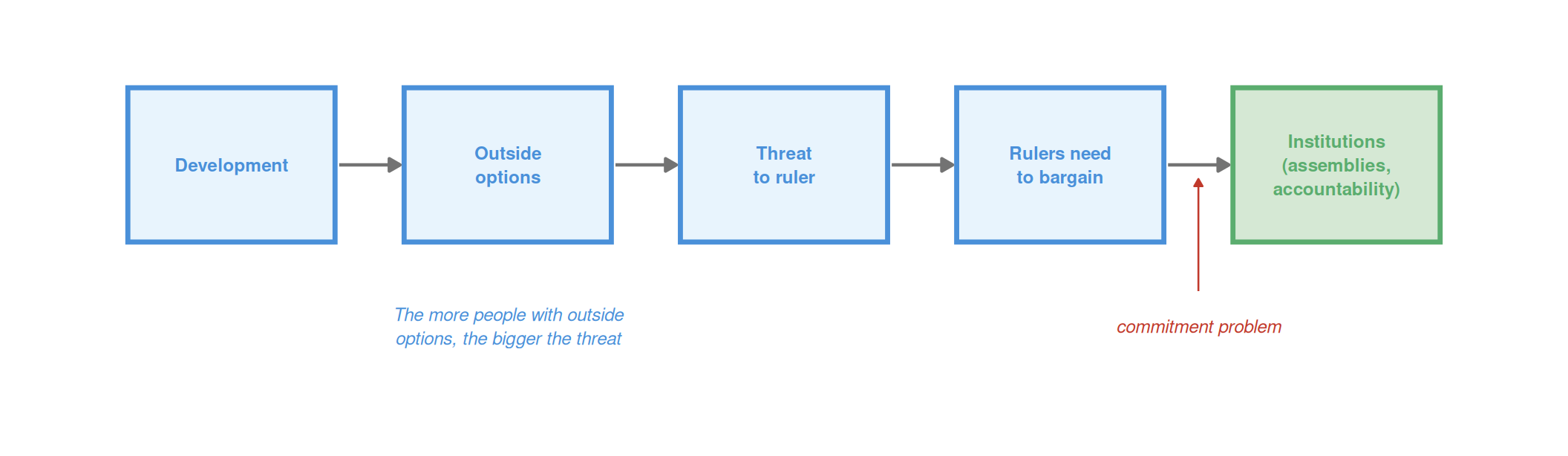
First Step: Outside Options

Agriculture \(\Longrightarrow\) Industry + Services

  • A bourgeoisie \(\rightarrow\) wealth more mobile and less legible
  • Financial system \(\rightarrow\) wealth can be moved abroad
  • Balance of power altered
    • People have outside option \(\rightarrow\) can escape taxation
    • Ruler now needs consent to tax \(\rightarrow\) forced to bargain
The more mobile the wealth, the more difficult the taxation

Second Step: Bargaining with the Rulers

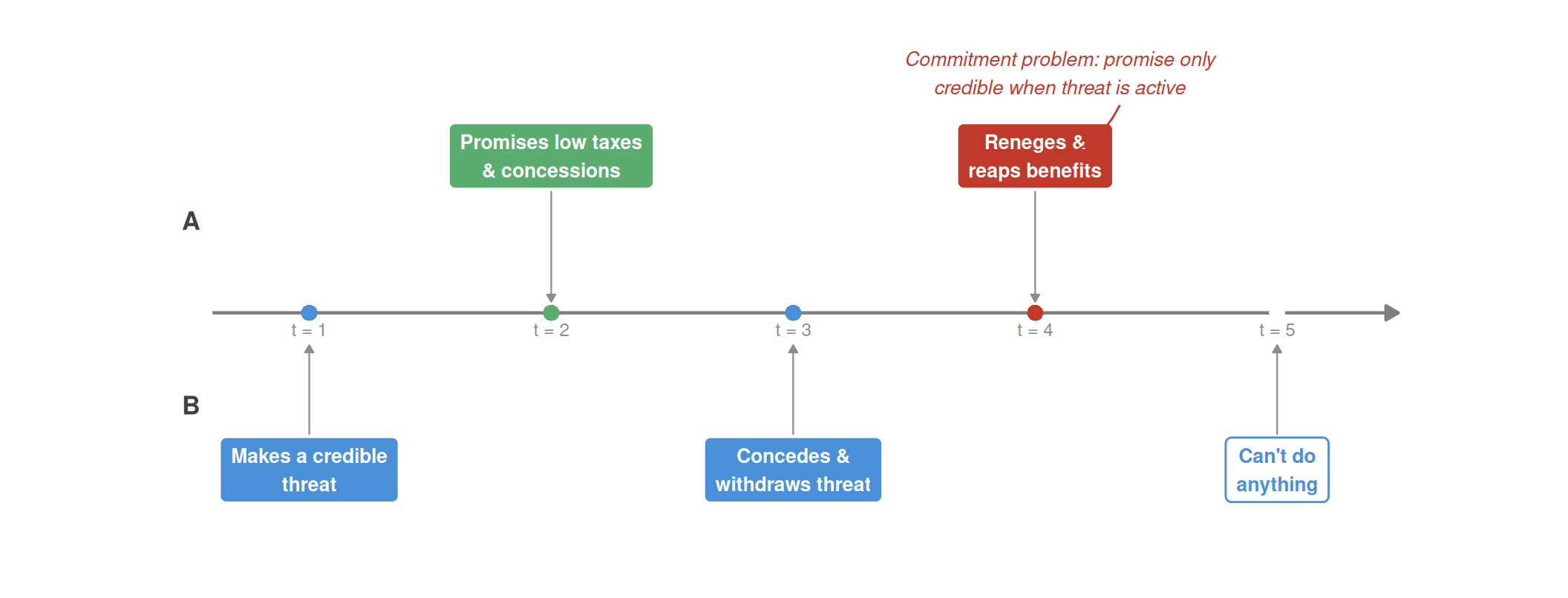
What is the problem?

  • The government can promise concessions
  • But future economic conditions may change or legibility can improve
  • Then the government can renege on past promises and expropriate
    • After all, it control the means of violence

\(\implies\) the threat to the ruler must be constant for the bargain to work
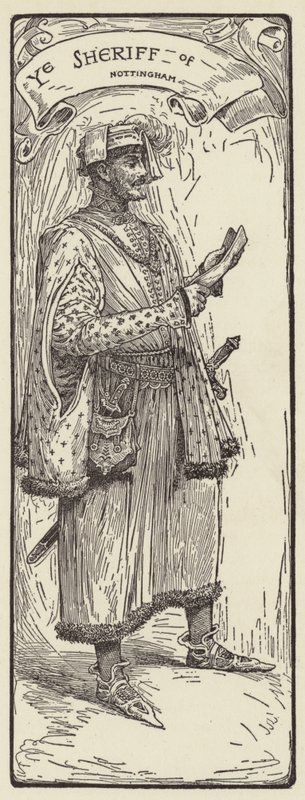
The Sheriff of Nottingham (Louis Rhead/Wikimedia Commons)

Interlude: Commitment Problems

Commitment problem/Time inconsistency \(\rightarrow\) key concept of social science

\(\implies\) knowing the commitment problem, the burgeoisie escapes taxation

Solving the Commitment Problem

Institutions could mitigate the commitment problem between government and bourgeoisie

  • Contracts \(\rightarrow\) write down who does what in advance
    • But the government is also the enforcer (recall the social contract)
  • Repeated interactions \(\rightarrow\) develop reputation for reliability
    • But the government needs resources now, doesn’t think about the future
  • Transfer power to the people \(\rightarrow\) removes temptation to renege by force
    • The ruler will always need consent in the future

Third Step: Institutions

An assembly forces the ruler to rule by consent, solving the commitment problem

The early English Parliament is a famous example (North & Weingast 1989)

  • Parliament \(\rightarrow\) control over taxation and royal spending
  • Parliament \(\rightarrow\) a veto player against expropriation
  • Commitment to repay debts becomes credible
  • Investors and merchants now willing to lend and invest

When Modernization Fails

Our Argument So Far

What the theory does not say: if development then (modern) democracy

What the theory says: development \(\implies\) \(\uparrow\) conditions for democracy

When Conditions Fail (1)
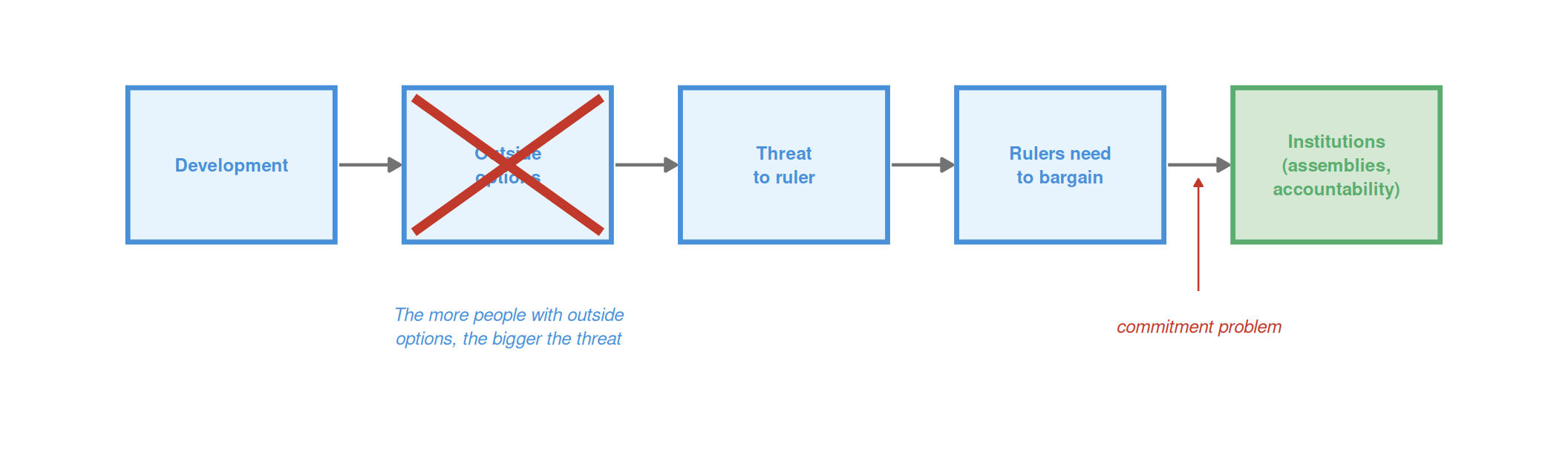
Outside options are not very valuable

  • The state controls the economy and leads modernization
    • E.g., China and Russia today, 19th century Prussia
  • Few alternatives to state employment or control
  • The state also has greater capacity to extract

When Conditions Fail (2)
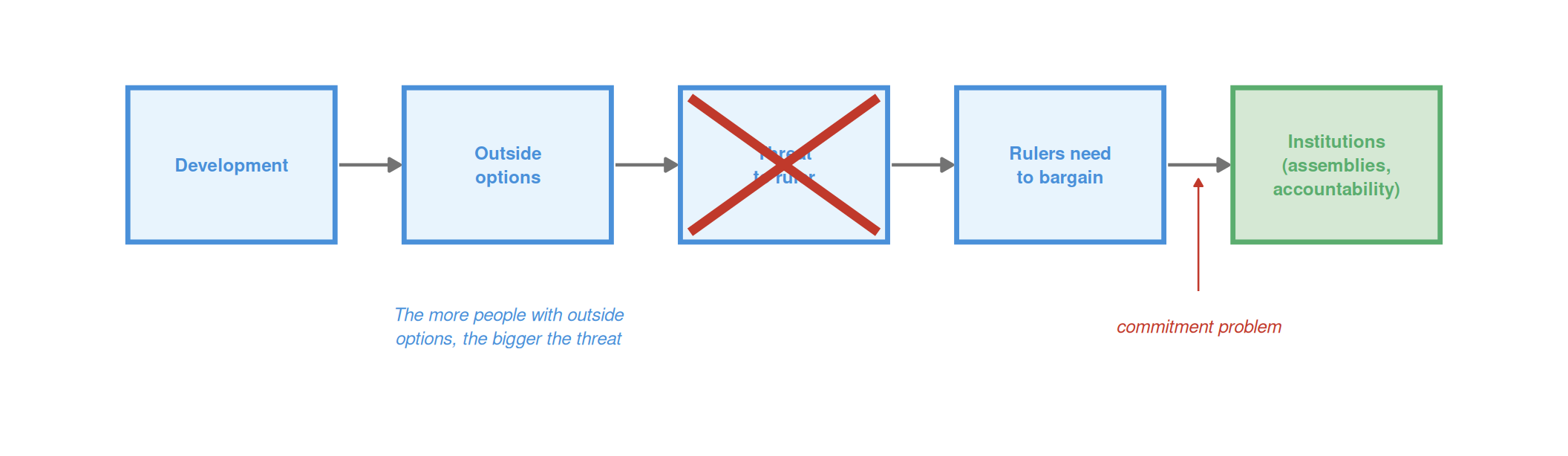
Rulers are not dependent on the people

  • The state relies on natural resources or foreign aid
    • E.g., Gulf emirates, Afghanistan
  • No need to seek consent for taxes
  • Can use revenues to co-opt opposition

Summing up

What We Learned

We have defined what democracy is and how it works

  • Modern democracy: competitive representation + mass participation
  • Competitive elections \(\rightarrow\) peaceful alternation + accountability

We have examined when we can expect development \(\rightarrow\) democracy

  • Development can increase the people’s outside options
  • Rulers dependent on people may be forced to cede some power
  • We can expect more democratic outcomes
    • the more people have better outside options
    • the better the outside options
    • the more dependent the government is

What is Missing?

An assembly of representatives is only part of modern democracy

Is this a modern democracy?

This is a congregation of barons, not a popular empowerment tool

\(\implies\) a precondition, not a guarantee

What is missing: Mass participation (next week)

Thank you!